Tech explained
Starship Ship Catch Explained: The Tower Catches the Upper Stage
Updated Nov 27, 2026 · 3 min read
On Flight 15, SpaceX's launch tower caught the returning Starship upper stage, the Ship, for the first time. The planned booster catch was called off, so it was a Ship catch, not a catch of both stages. A caught Ship can be inspected and flown again instead of being recovered from the ocean.
Watch onYouTube
Key points
- ●Starship has two parts: the Super Heavy booster and the Ship on top.
- ●The tower first caught a booster on Flight 5, on 13 October 2024.
- ●Flight 15 caught the Ship for the first time, but the booster catch was called off.
- ●Catching both stages on one flight is the next goal.
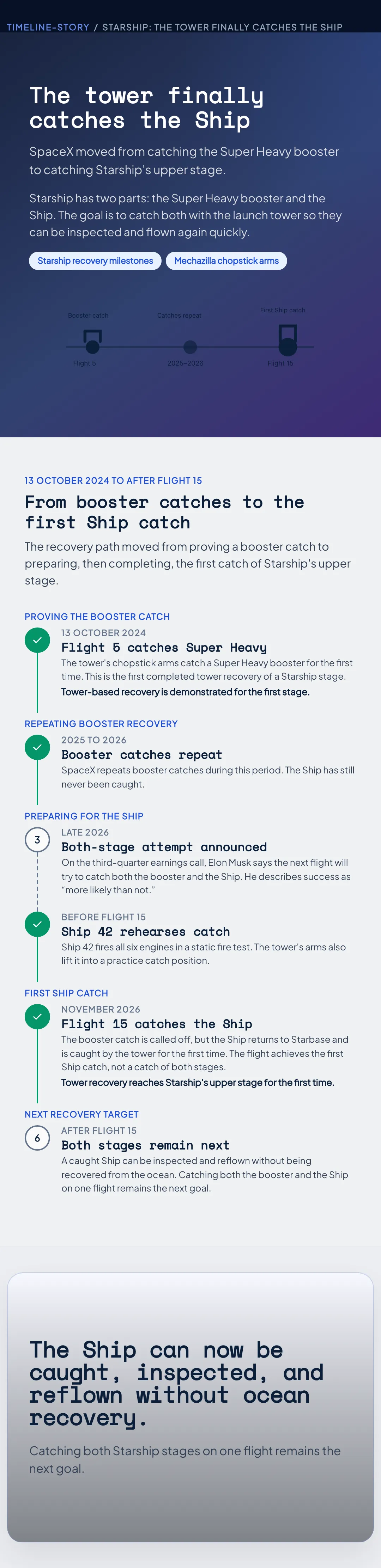
What happened on Flight 15
SpaceX's launch tower caught Starship's upper stage, the Ship, for the first time. On Flight 15 the planned booster catch was called off, but the Ship came back to Starbase and the tower's arms closed around it.
So the headline is a first, with a footnote: this was a Ship catch, not a catch of both stages on one flight.
The two parts of Starship
Starship is a two-stage rocket:
- Super Heavy is the booster at the bottom. It lifts everything off the pad.
- The Ship is the upper stage on top. It goes on toward space and later comes back.
The goal for both is the same. Instead of landing them somewhere far away, SpaceX wants the launch tower to catch them, so each stage can be inspected and flown again quickly. The tower's catching arms are nicknamed the chopsticks, and the whole tower is often called Mechazilla.
The road to the first Ship catch
The visual sheet above lays this out as a timeline. In short:
| When | What happened |
|---|---|
| 13 October 2024 | Flight 5: the chopstick arms catch a Super Heavy booster for the first time |
| 2025 to 2026 | Booster catches repeat; the Ship has still never been caught |
| Late 2026 | On the third-quarter earnings call, Elon Musk says the next flight will try to catch both stages, calling success "more likely than not" |
| Before Flight 15 | Ship 42 fires all six engines in a static fire test, and the tower lifts it into a practice catch position |
| November 2026 | Flight 15: booster catch called off, Ship caught by the tower |
The booster catch on Flight 5 proved the idea for the first stage. Flight 15 carried the same idea to the upper stage.
Why catching the Ship matters
A rocket stage you can catch is a stage you can check over and fly again. Without a catch, the Ship would have to be recovered from the ocean before anyone could look at it. Getting it back onto the tower skips that step, which is the whole point of the chopsticks.
That is also why the Ship catch is a bigger deal than one more booster catch. The booster catch had already been repeated many times. The Ship had never been caught at all.
What comes next
Both stages on one flight. Musk had said the flight would try for both, and the booster half was called off this time, so catching the booster and the Ship together remains the next target.
Sources: SpaceX and The Verge.
Frequently asked questions
Did SpaceX catch both Starship stages on Flight 15?
No. The booster catch was called off. The Ship returned to Starbase and the tower caught it, which made Flight 15 the first Ship catch, not a catch of both stages.
Why does SpaceX catch Starship with the tower?
So the stages can be inspected and flown again quickly. A caught Ship does not have to be recovered from the ocean first.
When was the first Super Heavy booster caught?
On 13 October 2024, on Flight 5, when the tower's chopstick arms caught a Super Heavy booster for the first time.
What is Mechazilla?
It is the nickname for the launch tower and its chopstick arms, the two arms that close around a returning stage and hold it.