Tech explained
eSIM vs Physical SIM Explained: Which One Should You Use in 2026?
Updated Nov 27, 2026 · 3 min read
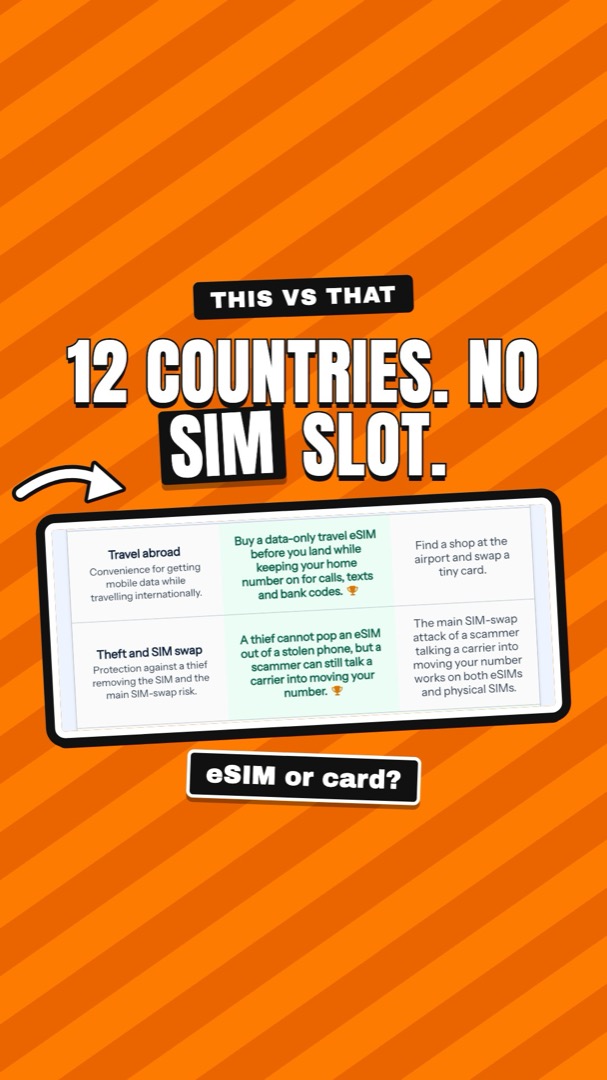
Pick eSIM if you travel a lot or want two numbers on one phone: you can buy a data-only travel eSIM before you land and keep your home number on. Keep a physical SIM card if you switch phones often or keep a spare, since the card moves to any unlocked phone in seconds. Either way, set a carrier PIN, because SIM swap scams work on both.
Key points
- ●iPhone 17 models are eSIM only in 12 places, including the US, Canada, Mexico and Japan; iPhone Air is eSIM only everywhere.
- ●Travel and two numbers: eSIM wins.
- ●Switching phones and a dead phone: the physical card wins.
- ●eSIM is a bit safer if your phone is stolen, but SIM swap scams work on both.
- ●Set a carrier PIN or port-out lock and use an authenticator app instead of SMS codes.
Why this question is back
The iPhone 14, in 2022, was the first iPhone sold without a SIM tray, and only in the US. Now the 2025 lineup has gone further:
- iPhone Air is eSIM only in every country.
- iPhone 17, 17 Pro and 17 Pro Max are eSIM only in 12 places: the US, Canada, Mexico, Japan, Guam, Bahrain, Kuwait, Oman, Qatar, Saudi Arabia, the UAE and the US Virgin Islands.
- Most other countries, including the UK and EU, still get a nano-SIM tray plus eSIM. Mainland China gets nano-SIM only.
So for a lot of people the choice is already made. If you buy an iPhone 17 in the US, there's no tray to put a card in. For everyone else, here's how the two compare.
Five rounds
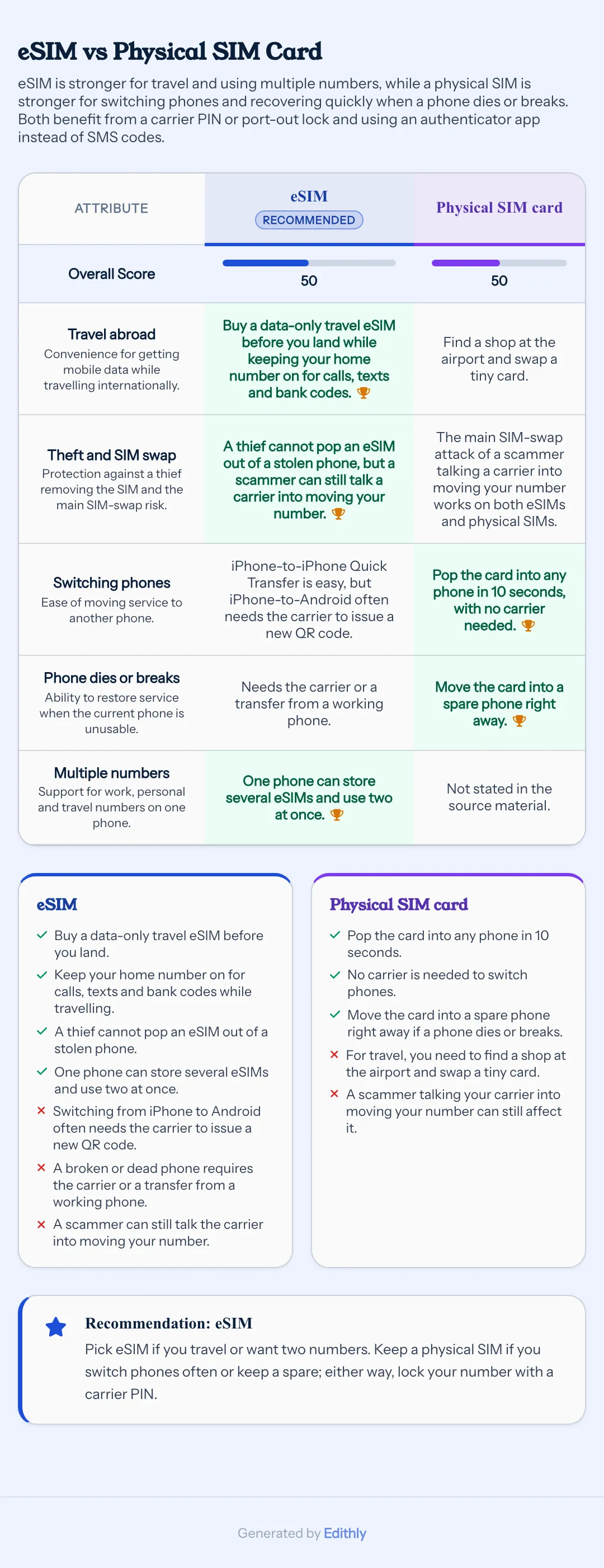
The visual sheet above scores them round by round:
| Round | eSIM | Physical SIM card | Winner |
|---|---|---|---|
| Travel abroad | Buy a data-only travel eSIM before you land; home number stays on | Find a shop at the airport and swap a tiny card | eSIM |
| Theft and SIM swap | A thief can't pop it out, but a scammer can still talk your carrier into moving your number | The carrier trick works here too | eSIM, slightly |
| Switching phones | Easy iPhone to iPhone; iPhone to Android often needs a new QR code from the carrier | Pop it into any phone in about 10 seconds, no carrier needed | Card |
| Phone dies or breaks | Needs the carrier or a transfer from a working phone | Move it into a spare right away | Card |
| Two numbers | One phone can store several eSIMs and use two at once | Not stated | eSIM |
Travel: eSIM wins
You buy a data-only travel eSIM before the plane lands. One example: about $4 for 1 GB for 3 days in Thailand, down to about $0.90 per GB on a 20 GB, 30-day plan. Prices vary by country and provider. On a dual-SIM phone your home line stays on, so calls, texts and bank codes still reach you.
Theft and SIM swap: closer than it looks
eSIM is a bit safer if your phone is stolen, since there's no card to pull out. But the main SIM swap attack doesn't touch your phone at all. A scammer talks your carrier into moving your number, and that works whether you use an eSIM or a card. The FBI's IC3 counted 1,611 SIM swap complaints and $68 million in losses in 2021.
What actually protects you:
- Set a carrier PIN or port-out lock on your number.
- Use an authenticator app instead of SMS codes where you can.
Switching phones and dead phones: the card wins
A physical card goes into any unlocked phone in seconds, no carrier needed. If your phone dies or breaks, the card goes straight into a spare.
eSIM is smooth between iPhones with Quick Transfer. Going from iPhone to Android often means asking your carrier for a new QR code. And if the phone is dead, you need the carrier or a transfer from a working phone.
Which should you use?
- Travel a lot, or want two numbers? Go eSIM.
- Switch phones often, or keep a spare? Keep the card.
- Either way: lock your number with a carrier PIN.
Neither choice is wrong. They just fail in different places, so pick the one whose weak spot you're least likely to hit.
Sources
Apple support, MacRumors, FCC, FBI IC3 and Airalo.
Frequently asked questions
Which iPhones are eSIM only?
iPhone Air is eSIM only in every country. iPhone 17, 17 Pro and 17 Pro Max are eSIM only in 12 places: the US, Canada, Mexico, Japan, Guam, Bahrain, Kuwait, Oman, Qatar, Saudi Arabia, the UAE and the US Virgin Islands. Most other countries, including the UK and EU, still get a nano-SIM tray plus eSIM, and mainland China gets nano-SIM only.
Is eSIM safer than a physical SIM?
A bit, against theft: a thief can't pull a card out of a stolen phone. But the main SIM swap trick is a scammer talking your carrier into moving your number, and that works on both. A carrier PIN or port-out lock protects either one.
Can I move an eSIM to a new phone?
iPhone to iPhone, Quick Transfer makes it easy. iPhone to Android often needs your carrier to issue a new QR code. A physical card just moves to any unlocked phone in seconds.
Is a travel eSIM worth it?
For many trips, yes. You buy a data-only plan before you land, for example about $4 for 1 GB for 3 days in Thailand, and your home number stays on for calls, texts and bank codes on a dual-SIM phone. Prices vary by country and provider.