Tech explained
Free VPN vs Paid VPN Explained: Which One Is Actually Safer
Updated Nov 27, 2026 · 3 min read
A paid VPN is the safer pick for daily use or public Wi-Fi. A VPN hides your browsing from the Wi-Fi owner and your internet provider, but the VPN company can see it instead, so how it makes money matters. Paid VPNs charge a few dollars a month; many free ones run on ads and tracking. If you use a free one, pick a known company that publishes an independent audit and a no-logs policy.
Key points
- ●A VPN moves your trust from the Wi-Fi and your internet provider to the VPN company.
- ●In a CSIRO study, 67% of free Android VPN apps had at least one third-party tracker.
- ●A 2026 study of 281 free Android VPN apps found 29 that leaked traffic outside the tunnel.
- ●Free VPNs usually cap data, speed or server choice.
- ●Free is fine from a known company with an independent audit and a no-logs policy. Daily or on public Wi-Fi, pay.
What a VPN actually hides
A VPN sends your traffic through a tunnel to the VPN company's servers. That hides your browsing from the café Wi-Fi and from your internet provider.
The part people skip: the VPN company can see it instead. A VPN doesn't remove the middleman, it swaps one for another. So the real question behind "free or paid?" is who you're trusting, and how they pay for the servers.
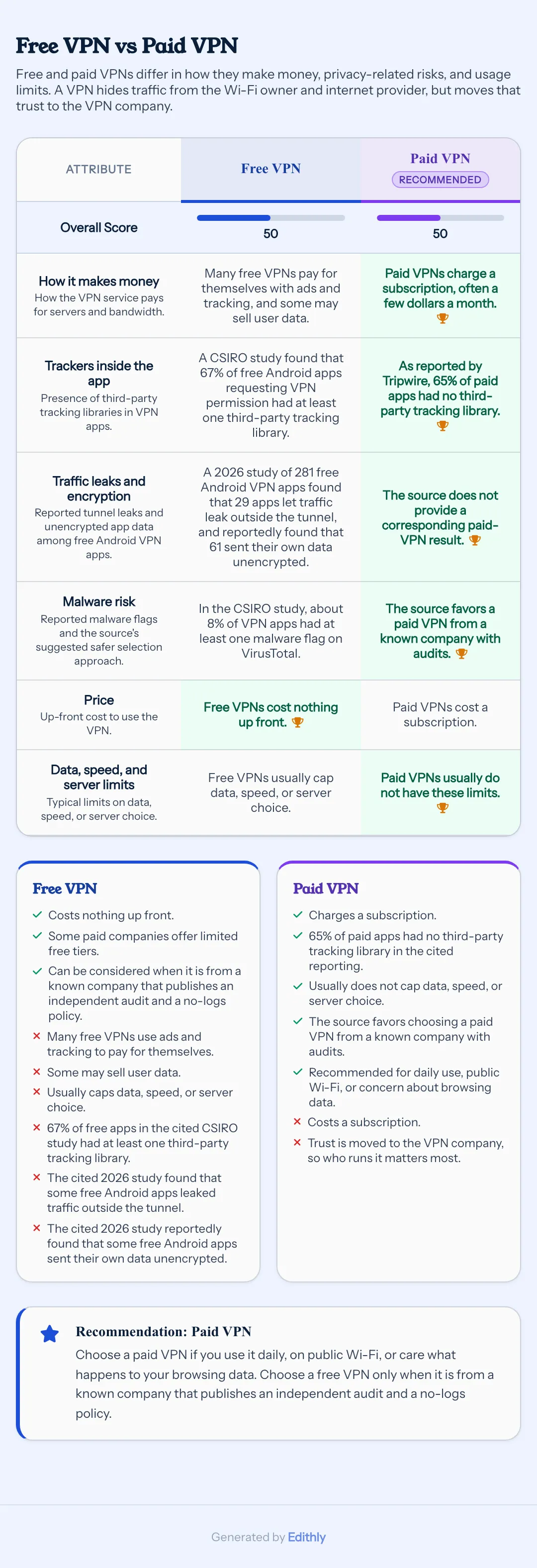
The visual sheet above compares the two on six points. Here are the four rounds that decide it.
Round 1: who pays for the servers
Servers and bandwidth cost money, so every VPN gets paid somehow.
- Paid VPNs charge a subscription, often a few dollars a month. That's the whole business.
- Many free VPNs pay for themselves with ads and tracking, and some may sell user data.
The numbers back this up. A CSIRO study of Android apps that request VPN permission found that 67% of the free ones had at least one third-party tracking library inside. On the paid side, Tripwire reported that 65% of paid apps had no third-party tracking library. The same CSIRO study found about 8% of VPN apps had at least one malware flag on VirusTotal.
Point to paid.
Round 2: leaks
A VPN is only useful if your traffic actually stays in the tunnel. A 2026 study tested 281 free Android VPN apps and found 29 that let traffic leak outside it. It also reportedly found 61 that sent their own app data unencrypted.
The same study found the Play Store's "Verified" badge works more like marketing than a security check. So a badge on the listing doesn't settle it.
The study didn't publish a matching result for paid VPNs, so this round is about the risk on the free side. Point to paid.
Round 3: price
Free costs nothing up front. Paid costs a subscription. No argument here.
Point to free.
Round 4: limits
Free VPNs usually cap something: data, speed or which servers you can pick. Paid VPNs usually don't. Some paid companies also offer a limited free tier, which is one way to get a free VPN from a known name.
Point to paid.
The scorecard
| Free VPN | Paid VPN | |
|---|---|---|
| How it makes money | Often ads and tracking; some may sell data | Subscription, a few dollars a month |
| Trackers | 67% of free Android apps had one (CSIRO) | 65% of paid apps had none (Tripwire) |
| Leaks | 29 of 281 free Android apps leaked (2026 study) | No matching result in the source |
| Price | Nothing up front | Subscription |
| Limits | Usually caps data, speed or servers | Usually no caps |
Which one to pick
Pay if you use a VPN daily, on public Wi-Fi, or you care what happens to your browsing data.
Free is fine when it comes from a known company that publishes an independent audit and a no-logs policy. That combination is what separates a free tier from a free app that pays for itself with your data.
The trap to watch for
Picking a VPN by its store rating or a "Verified" badge. Neither tells you how the company makes money or whether traffic stays in the tunnel. Check for the audit and the no-logs policy first. If you can't find them, that's your answer.
Sources
CSIRO's study of Android VPN apps, Tripwire's reporting on paid VPN apps, and a 2026 study of 281 free Android VPN apps.
Frequently asked questions
Are free VPNs safe?
Some are, many aren't. A CSIRO study found 67% of free Android VPN apps had at least one third-party tracking library, and a 2026 study of 281 free Android VPN apps found 29 that leaked traffic outside the tunnel. A free VPN from a known company with an independent audit and a no-logs policy is the safer kind.
How do free VPNs make money?
Many pay for their servers with ads and tracking, and some may sell user data. Paid VPNs charge a subscription, often a few dollars a month.
Can a VPN company see my browsing?
Yes. A VPN hides your traffic from the café Wi-Fi and your internet provider, but the VPN company sits where they used to. That's why who runs it, and how they pay for it, matters most.
Does the Play Store Verified badge mean a VPN is safe?
Not on its own. The 2026 study found the badge works more like marketing than a security check, so look for an independent audit and a no-logs policy instead.