Tech explained
Voyager 1 One Light-Day From Earth Explained: 48-Hour Replies
Updated Nov 27, 2026 · 3 min read
A light-day is the distance light travels in 24 hours. NASA expected Voyager 1, launched in 1977, to reach that distance from Earth on 18 November 2026: 16.094 billion miles, or 25.902 billion km. A command now takes a full day to reach it, and the reply takes another day to come back.
Key points
- ●One light-day is 16.094 billion miles (25.902 billion km), the distance light covers in 24 hours.
- ●A command and its reply now take 48 hours in total.
- ●NASA says no human-made object has been this far from Earth.
- ●Only 2 of Voyager 1's 10 science instruments are still on.
- ●Its nuclear power supply loses about 4 watts a year.
What happened
NASA expected Voyager 1 to reach one light-day from Earth on 18 November 2026. The probe launched in 1977 and has been flying for 49 years. NASA says no human-made object has been this far from Earth.
What a light-day means
A light-day sounds like a unit of time, but it's a distance: how far light travels in 24 hours. For Voyager 1 that's 16.094 billion miles, or 25.902 billion kilometres.
Radio signals move at the speed of light, so the distance turns straight into a delay:
- A command from Earth takes 24 hours to arrive.
- Voyager's answer takes another 24 hours to come back.
So every conversation with the spacecraft now has a 48-hour round trip. Think of texting a friend and waiting two days for the reply, every single time.
That changes how you fly a spacecraft. Nobody can steer Voyager 1 live. You send a command, and you won't know whether it worked until two days later, when the reply finally lands.
A 49-year journey
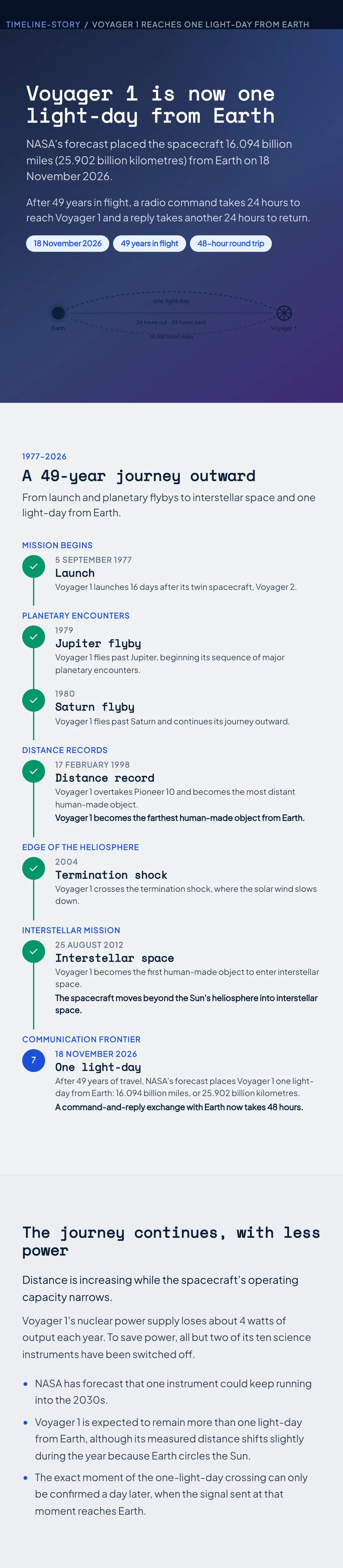
The visual sheet above lays the mission out as a timeline:
| Date | Milestone |
|---|---|
| 5 September 1977 | Launch, 16 days after its twin, Voyager 2 |
| 1979 | Jupiter flyby |
| 1980 | Saturn flyby |
| 17 February 1998 | Overtakes Pioneer 10 as the most distant human-made object |
| 2004 | Crosses the termination shock, where the solar wind slows down |
| 25 August 2012 | First human-made object to enter interstellar space |
| 18 November 2026 | One light-day from Earth |
Still flying, with less power
Distance keeps growing while the spacecraft's power shrinks. Voyager 1's nuclear power supply loses about 4 watts of output each year. To save power, all but two of its ten science instruments have been switched off. NASA has forecast that one instrument could keep running into the 2030s.
Two small details worth knowing
First, the crossing can only be confirmed a day late. The signal sent at the moment Voyager 1 reached one light-day needs a full day to reach Earth.
Second, the number wobbles. Voyager 1 is expected to stay more than one light-day away from now on, but its measured distance from Earth shifts slightly during the year because Earth moves around the Sun, sometimes toward the probe and sometimes away.
Sources
Reported by NASA, Engadget and ScienceAlert.
Frequently asked questions
What is a light-day?
It's a distance, not a time: how far light travels in one day. For Voyager 1 that works out to 16.094 billion miles, or 25.902 billion kilometres.
How long does it take to talk to Voyager 1?
A radio command takes about 24 hours to reach it, and its reply takes another 24 hours to get back, so a full exchange takes 48 hours.
Is Voyager 1 still working?
Yes, with less power each year. Its nuclear power supply loses about 4 watts a year, and all but two of its ten science instruments have been switched off to save power. NASA has forecast that one instrument could keep running into the 2030s.
How do we know exactly when Voyager 1 crossed one light-day?
Only after the fact. The signal sent at the moment of crossing takes a day to reach Earth, so the crossing can be confirmed a day later. The measured distance also shifts a little during the year because Earth circles the Sun.