Tech explained
Vulcan Rocket Failure Explained: 40 Amazon Leo Satellites Lost
Updated Nov 27, 2026 · 3 min read
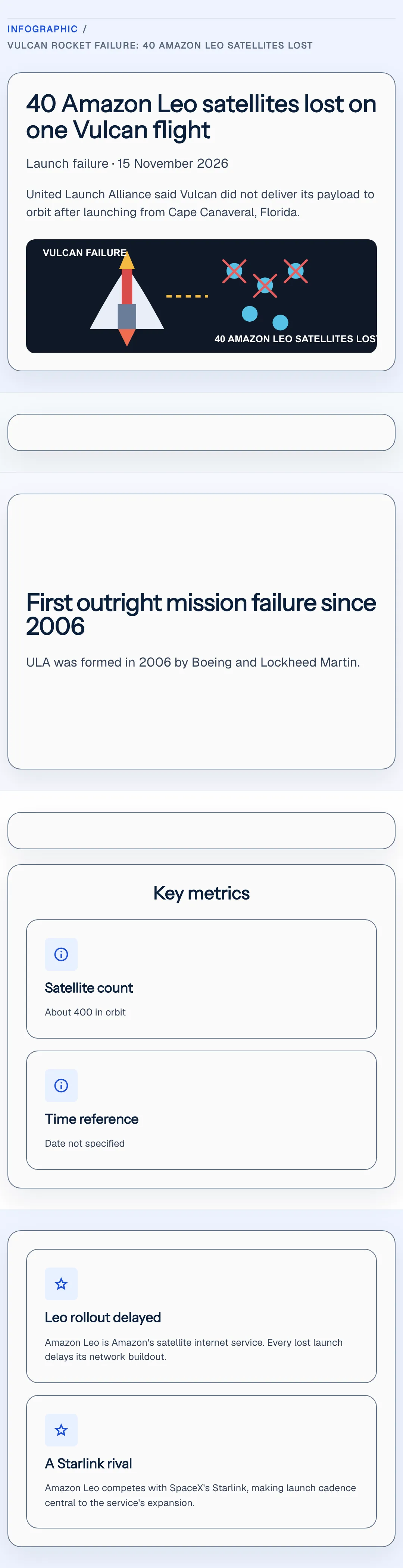
On 15 November 2026, United Launch Alliance's Vulcan rocket launched from Cape Canaveral and failed to reach orbit, destroying all 40 Amazon Leo internet satellites on board. It was Vulcan's first flight after about nine months grounded and ULA's first outright failure since 2006. The cause isn't known yet.
Key points
- ●All 40 Amazon Leo satellites on the flight were lost.
- ●It was Vulcan's return to flight after about nine months grounded over booster problems.
- ●ULA's first outright failure since it was formed in 2006.
- ●Amazon has about 400 Leo satellites in orbit; the FCC wanted 1,600 by July.
- ●Blue Origin, which builds Vulcan's main engines, is helping investigate.
What happened
On 15 November 2026, United Launch Alliance's Vulcan rocket lifted off from Cape Canaveral, Florida. It never reached orbit. ULA said Vulcan didn't deliver its payload, and all 40 Amazon Leo satellites on board were lost.
One rocket, forty satellites. That's the number on top of the visual sheet above.
What Amazon Leo is
Amazon Leo is Amazon's satellite internet service: internet from space, delivered by a large group of satellites circling the Earth. It's Amazon's answer to SpaceX's Starlink. A network like that only works once enough satellites are up, so how often you can launch decides how fast the service grows.
Why this failure stings
Three things make this one worse than a single bad day:
- It was a return to flight. Vulcan had been grounded for about nine months over booster problems. This was its first flight back.
- It broke a long record. ULA was formed in 2006 by Boeing and Lockheed Martin. This was its first outright mission failure since then.
- Others were waiting. The Pentagon was waiting on this flight too.
The numbers behind Amazon's problem
| Satellites lost on this flight | 40 |
| Vulcan launches Amazon has bought | 38 |
| Leo satellites in orbit | about 400 |
| What the FCC wanted by July | 1,600 |
Amazon is a long way from 1,600. With 38 of its launches booked on Vulcan, Amazon needs this rocket flying, and every lost launch delays the network buildout.
A short timeline
- 2006: Boeing and Lockheed Martin form United Launch Alliance.
- The months before launch: Vulcan sits grounded for about nine months over booster problems.
- 15 November 2026: Vulcan returns to flight from Cape Canaveral, fails to reach orbit, and 40 Amazon Leo satellites are lost.
- July: the date by which the FCC wanted 1,600 Leo satellites up. Amazon has about 400.
Read in order, it's a rocket that had just been cleared to fly again, carrying a customer that was already behind schedule.
What happens next
The cause isn't known yet. Blue Origin, the company that builds Vulcan's main engines, is helping with the investigation. Until there's an answer, it's hard to say when Vulcan flies again or how much Amazon's Leo schedule slips.
The open question is the one in the sheet's title: can Amazon still catch Starlink? With about 400 satellites up and 40 just lost, the gap just got wider.
Sources
Reported by Spaceflight Now, Space.com, Engadget and Aviation Week.
Frequently asked questions
What is Amazon Leo?
Amazon Leo is Amazon's satellite internet service, internet beamed down from a network of satellites in orbit. It competes with SpaceX's Starlink.
Why did the Vulcan rocket fail?
Nobody knows yet. The cause hadn't been found when the failure was reported. Blue Origin, which builds Vulcan's main engines, is helping with the investigation.
How many launches has Amazon bought on Vulcan?
Amazon has bought 38 Vulcan launches, which is why a failure and another grounding hurt its rollout plans.
Can Amazon Leo still catch Starlink?
It's harder now. Amazon has roughly 400 satellites in orbit, well short of the 1,600 the FCC wanted by July, and every lost launch delays the network buildout.