Tech explained
Riemann Hypothesis Lean Proof Explained: Proved or Not Yet?
Updated Nov 27, 2026 · 3 min read
On 20 November 2026, Anthropic research scientist Levent Alpöge released 175,187 Lean 4 files he says prove the Generalized Riemann Hypothesis, which also covers the original. Lean is a proof checker that accepts a proof only if every step follows. The proof is not accepted yet: mathematicians still have to review it, and Clay's $1 million prize needs journal publication and two years of acceptance.
Key points
- ●The Riemann Hypothesis dates to Bernhard Riemann's 1859 paper on how primes are spread out.
- ●175,187 Lean 4 files are claimed to machine-check a proof of it and its generalized version.
- ●Lean accepts a proof only if every step follows.
- ●Computer-checked does not yet mean formally accepted.
What was released
On 20 November 2026, Anthropic research scientist Levent Alpöge released an archive of 175,187 Lean 4 files. He says they prove the Generalized Riemann Hypothesis, the version that also covers the original. He reportedly built the files with help from the AI model Claude.
If it holds up, it settles a problem that is 167 years old. That "if" is the whole story right now.
The generalized version matters because it is the bigger claim. Prove it, and the original Riemann Hypothesis comes along as a special case.
What Lean checks
Lean is a proof checker. You write a proof in its language, and it accepts the proof only if every step follows from the steps before it. A human reader can skim past a gap; Lean can't.
That is why a Lean proof is a strong claim. A paper proof is checked by people reading it. A Lean proof is checked by software, line by line, every time it compiles. Outside mathematicians have reportedly compiled the code. But Lean checks logic, not the acceptance process, and the acceptance process is what the prize rules care about.
From 1859 to now
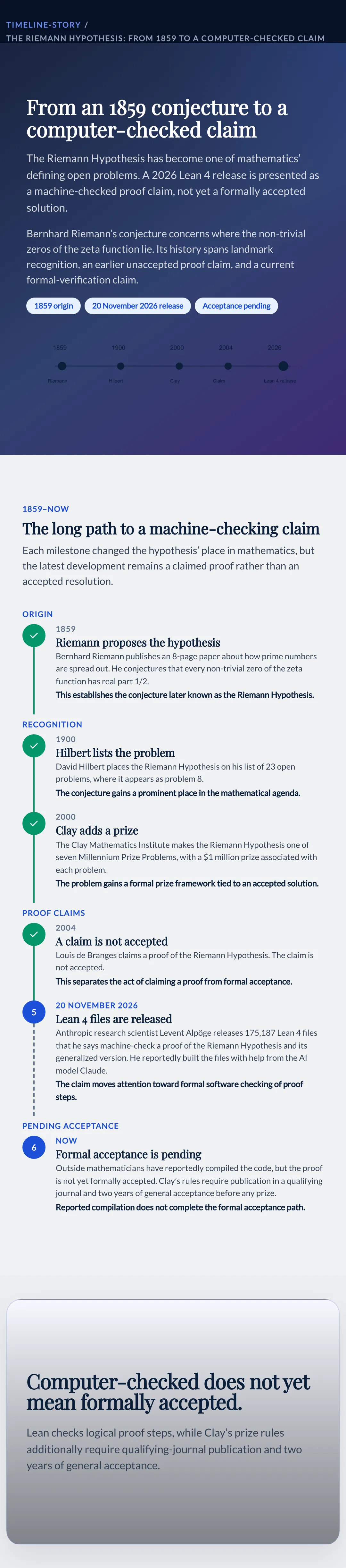
The visual sheet above draws the full timeline. In short:
| Year | Milestone |
|---|---|
| 1859 | Bernhard Riemann's 8-page paper on how primes are spread out: every non-trivial zero of the zeta function has real part 1/2 |
| 1900 | David Hilbert puts it on his list of 23 open problems, as problem 8 |
| 2000 | The Clay Mathematics Institute makes it one of seven Millennium Prize Problems, $1 million each |
| 2004 | Louis de Branges claims a proof; it is not accepted |
| 2026 | The Lean 4 files are released |
The 2004 row is worth remembering. Claiming a proof and having it accepted are two different events.
Why it isn't accepted yet
Two things still have to happen:
- Review. Independent mathematicians have to check the work, all 175,187 files of it.
- The prize rules. Clay requires publication in a qualifying journal and two years of general acceptance before any prize is paid.
Until then, the right word is "claimed". That isn't a knock on the work. It's how every big result goes: the claim comes first, and acceptance comes after other people have had time to test it. Computer-checked does not yet mean formally accepted.
Sources: Interesting Engineering, Unite.ai and the Clay Mathematics Institute.
Frequently asked questions
Has the Riemann Hypothesis been proved?
Not officially. A proof has been claimed in Lean 4 files released on 20 November 2026, but it is not formally accepted. Independent mathematicians still have to review it.
What is Lean?
Lean is a proof checker: software that accepts a proof only if every logical step follows from the ones before it. Lean 4 is the version used for this claim.
Will the Riemann Hypothesis proof win the $1 million Millennium Prize?
Not yet. The Clay Mathematics Institute's rules require publication in a qualifying journal and two years of general acceptance before any prize.
What does the Riemann Hypothesis say?
Bernhard Riemann conjectured in 1859 that every non-trivial zero of the zeta function has real part 1/2. It matters because it describes how prime numbers are spread out.