Tech explained
Ladybird Browser Alpha Explained: A New Engine From Scratch
Updated Nov 27, 2026 · 3 min read
Ladybird is a web browser with its own engine, built from scratch rather than forked from Google's Blink, Apple's WebKit or Mozilla's Gecko. It launched in alpha for macOS and Linux on 23 November 2026, with a beta planned for 2027 and a stable release for 2028. It's made by a nonprofit funded only by donations and sponsors.
Key points
- ●Almost every browser runs on Blink (Chrome, Edge, Opera), WebKit (Safari) or Gecko (Firefox).
- ●Ladybird's engine is built from scratch and isn't a fork of any of them.
- ●The alpha is macOS and Linux only; Windows comes later.
- ●It's an alpha: some sites break, it crashes, and there are no security promises yet.
- ●Beta is planned for 2027 and a stable release for 2028.
What happened
Ladybird, the first new browser engine in years, launched in alpha for macOS and Linux on 23 November 2026. It uses a rolling channel with automatic updates.
Why a new engine matters
Almost every browser you use runs on one of three engines:
| Engine | Made by | Browsers |
|---|---|---|
| Blink | Google (Chromium) | Chrome, Microsoft Edge, Opera |
| WebKit | Apple | Safari |
| Gecko | Mozilla | Firefox |
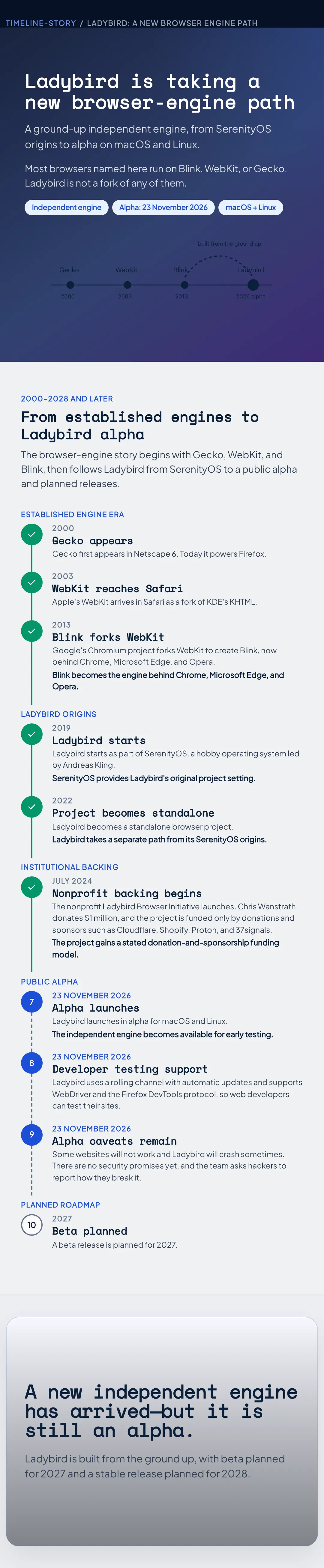
The engine is the part that reads a web page's code and draws it on your screen. Ladybird's engine is built from scratch, so it isn't a fork of any of the three. That's the news here. Chrome, Edge and Opera look like three choices, but under the hood they share one engine. Ladybird is a genuinely separate fourth option. The timeline on the visual sheet above shows how the existing engines are related: Gecko first appeared in Netscape 6 in 2000, WebKit reached Safari in 2003 as a fork of KDE's KHTML, and Google forked WebKit in 2013 to create Blink.
Where Ladybird came from
- 2019: Ladybird starts as part of SerenityOS, a hobby operating system led by Andreas Kling.
- 2022: It becomes a standalone browser project.
- July 2024: The nonprofit Ladybird Browser Initiative launches. Chris Wanstrath donates $1 million, and the project is funded only by donations and sponsors such as Cloudflare, Shopify, Proton and 37signals.
- 23 November 2026: Alpha on macOS and Linux.
What the alpha can and can't do
It's rough, and the team says so. Some websites will not work, Ladybird will crash sometimes, and there are no security promises yet. The team is asking hackers to report how they break it.
That's an honest label for an alpha, and a good reason not to log in to anything important with it yet.
For web developers, it's already useful: Ladybird supports WebDriver and the Firefox DevTools protocol, so you can test your own sites against a fourth engine.
What's next
Windows support comes later. A beta is planned for 2027 and a stable release for 2028. Until then, treat it as something to try, not your everyday browser. If you build websites, the alpha is the time to check that your pages work in it, using the WebDriver and DevTools support the alpha already has.
Sources
Ladybird, The Verge and Wikipedia.
Frequently asked questions
What browser engine does Ladybird use?
Its own. Ladybird's engine is built from the ground up and is not a fork of Blink, WebKit or Gecko, the three engines behind almost every browser people use.
Is Ladybird available on Windows?
Not yet. The alpha that launched on 23 November 2026 runs on macOS and Linux, and Windows support comes later.
Who funds Ladybird?
The nonprofit Ladybird Browser Initiative, launched in July 2024. It's funded only by donations and sponsors, such as Cloudflare, Shopify, Proton and 37signals, and Chris Wanstrath donated $1 million.
Should I use Ladybird as my main browser?
Not yet. It's an alpha: some websites won't work, it will crash sometimes, and there are no security promises yet. It's best for trying out and for web developers testing their sites.