CS concepts
Python History Explained: From a 1989 Hobby to Number 1
Updated Nov 28, 2026 · 3 min read
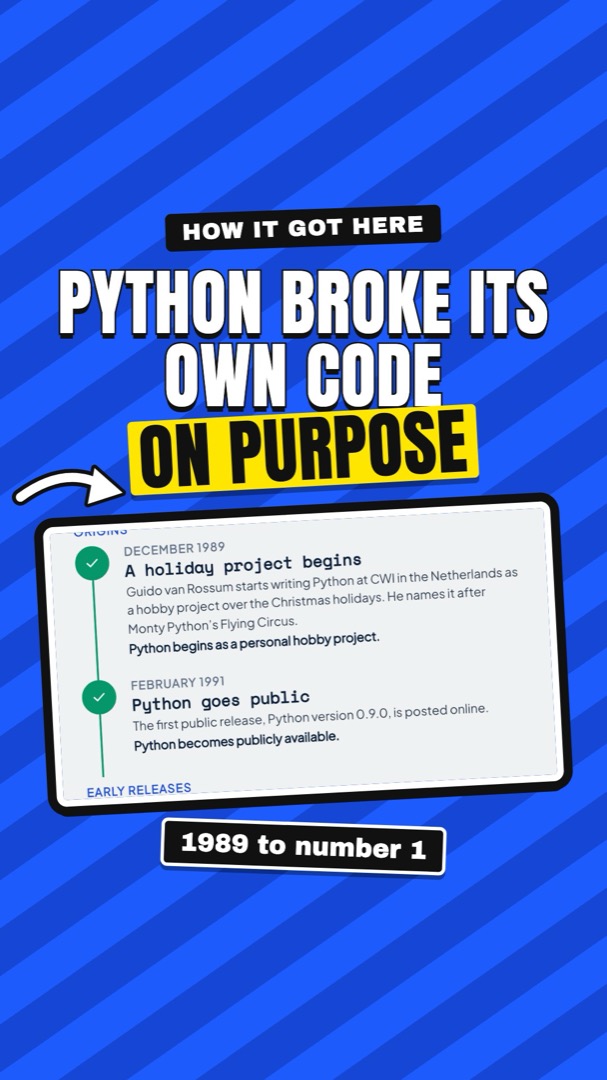
Guido van Rossum started Python in December 1989 at CWI in the Netherlands as a holiday hobby, and named it after Monty Python's Flying Circus. Version 0.9.0 went public in February 1991, Python 3 broke old code on purpose in 2008, Python 2 retired in January 2020, and Python reached number 1 on the TIOBE index in October 2021.
Key points
- ●December 1989: Guido van Rossum starts Python as a holiday hobby at CWI.
- ●The name comes from Monty Python's Flying Circus, not the snake.
- ●Python 3.0 (December 2008) broke old code on purpose; print became a function.
- ●Python 2 reached end of life in January 2020, 12 years after Python 3.
- ●October 2024: Python 3.13 shipped an experimental build without the GIL.
A holiday project in 1989
Python started small. In December 1989, Guido van Rossum began writing it at CWI in the Netherlands as a hobby project over the Christmas holidays.
He named it after Monty Python's Flying Circus, the comedy show. Not the snake. Today it's called the default language for AI, data science, scripting and coding interviews.
The timeline
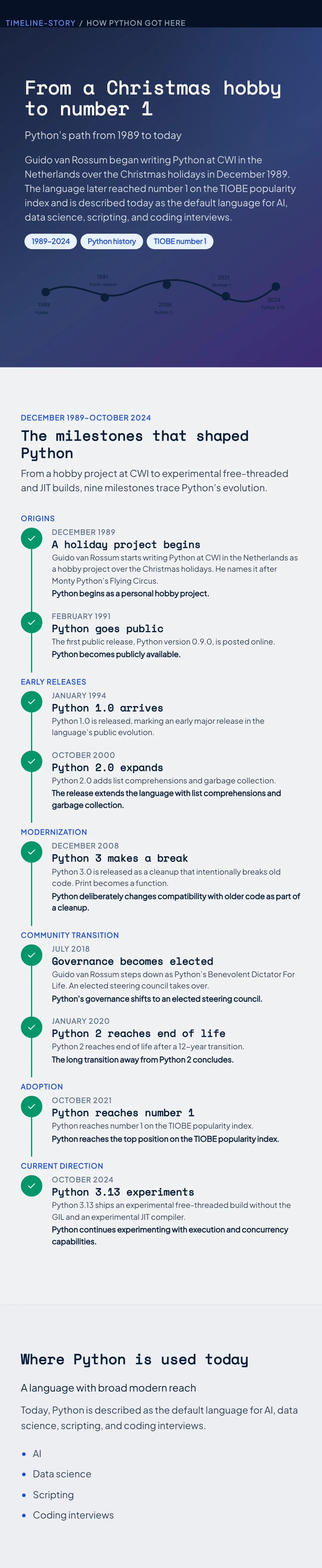
The visual sheet above lays out nine milestones. Here they are in order:
| Date | Milestone |
|---|---|
| December 1989 | Guido van Rossum starts Python at CWI as a holiday hobby |
| February 1991 | First public release, version 0.9.0 |
| January 1994 | Python 1.0 |
| October 2000 | Python 2.0 adds list comprehensions and garbage collection |
| December 2008 | Python 3.0 breaks old code on purpose; print becomes a function |
| July 2018 | Guido steps down as Benevolent Dictator For Life; an elected steering council takes over |
| January 2020 | Python 2 reaches end of life |
| October 2021 | Number 1 on the TIOBE index |
| October 2024 | Python 3.13 ships an experimental free-threaded build (no GIL) and an experimental JIT compiler |
Early releases: from 0.9 to 2.0
The first public release, 0.9.0, came out in February 1991, a little over a year after the project started. Python 1.0 followed in January 1994.
Python 2.0 in October 2000 brought list comprehensions, the one-line way to build a list like [x * x for x in nums], along with garbage collection. If you write Python in interviews today, you use comprehensions all the time, and they've been around since 2000.
Python 3: the break on purpose
December 2008 is the most famous moment in Python's history. Python 3.0 was a cleanup, and it broke old code on purpose. The change everyone remembers is that print became a function:
print "hello"     # Python 2
print("hello")    # Python 3
Breaking compatibility meant every Python 2 project had to be updated, and that took a long time. Python 2 didn't reach end of life until January 2020, a full 12 years after Python 3 came out.
A new way to run the language
For most of its life, Python had one final decision-maker. Guido van Rossum held the title Benevolent Dictator For Life. In July 2018 he stepped down, and an elected steering council took over. The language now moves forward through that council rather than one person.
Number 1, and what came next
In October 2021, Python reached number 1 on the TIOBE index, a popularity ranking of programming languages.
It kept changing after that. In October 2024, Python 3.13 shipped two experiments: a free-threaded build without the GIL (the global interpreter lock), and an experimental JIT compiler. Both are labeled experimental, so they're a direction, not the default yet.
Why the history still shows up in code
You'll run into this history even if you only write modern Python. Old tutorials and Stack Overflow answers sometimes use print "hello" with no parentheses. That's Python 2 syntax, and Python 2 hasn't been supported since January 2020, so treat that code as something to update, not copy.
List comprehensions are the opposite: they've been in the language since Python 2.0, and they're still the idiomatic way to build a list. And when people talk about the GIL, the 3.13 free-threaded build is the experiment they mean.
What to remember
If you only keep three dates, keep these: 1989 for the start, 2008 for Python 3, and 2020 for the end of Python 2. They explain why old tutorials sometimes write print without parentheses, and why you'll still hear people talk about "Python 2 vs 3."
Sources: Python Software Foundation and python.org release history, TIOBE.
Frequently asked questions
Who created Python and when?
Guido van Rossum started writing Python in December 1989 at CWI in the Netherlands, as a hobby project over the Christmas holidays. The first public release, version 0.9.0, came out in February 1991.
Why is Python called Python?
Guido van Rossum named it after the comedy show Monty Python's Flying Circus. It has nothing to do with the snake.
Why did Python 3 break old code?
Python 3.0, released in December 2008, was a deliberate cleanup of the language. Fixing old design choices meant some Python 2 code would no longer run. The best-known change is that print became a function, so print "hi" had to become print("hi").
When did Python 2 end?
Python 2 reached end of life in January 2020, about 12 years after Python 3 came out.