CS concepts
Git History Explained: From a 2005 License Fight to Git 3.0
Updated Nov 27, 2026 · 3 min read
Git was created in April 2005, after the free license that let Linux kernel developers use the paid BitKeeper tool was withdrawn. Linus Torvalds wrote his own tool, made Git's first commit on 7 April 2005, and handed maintenance to Junio Hamano that July. GitHub launched in 2008, and Git 3.0 plans main and SHA-256 as defaults, with no release date set.
Key points
- ●Git exists because Linux lost its free BitKeeper license in April 2005.
- ●Git's first commit was on 7 April 2005; Git 1.0 came that December.
- ●Junio Hamano has maintained Git since July 2005.
- ●Git 2.28 (July 2020) let you pick your default branch name; GitHub moved new repos to main in October 2020.
- ●Git 3.0 plans main and SHA-256 as defaults, with no date yet.
What Git is
Git is the version control system most developers use to track changes to code. It records every commit, lets people work on branches, and lets teams merge their work back together. In 2022, Stack Overflow's developer survey found that 93% of developers use Git.
It didn't start as a grand plan. It started because Linux lost a tool overnight.
How it started: the BitKeeper license fight
Before Git, Linux kernel developers used BitKeeper, a paid version control tool that they were allowed to use for free. In April 2005, that free license was withdrawn.
So Linus Torvalds, who created Linux, started writing his own tool.
The first year, month by month
Git moved fast in 2005:
- 7 April 2005: Git's first commit. It described Git as "the information manager from hell." Within days, Git was tracking its own source code.
- June 2005: Linux 2.6.12 became the first kernel release managed with Git.
- July 2005: Linus handed Git maintenance to Junio Hamano, who still maintains it today.
- December 2005: Git 1.0 was released.
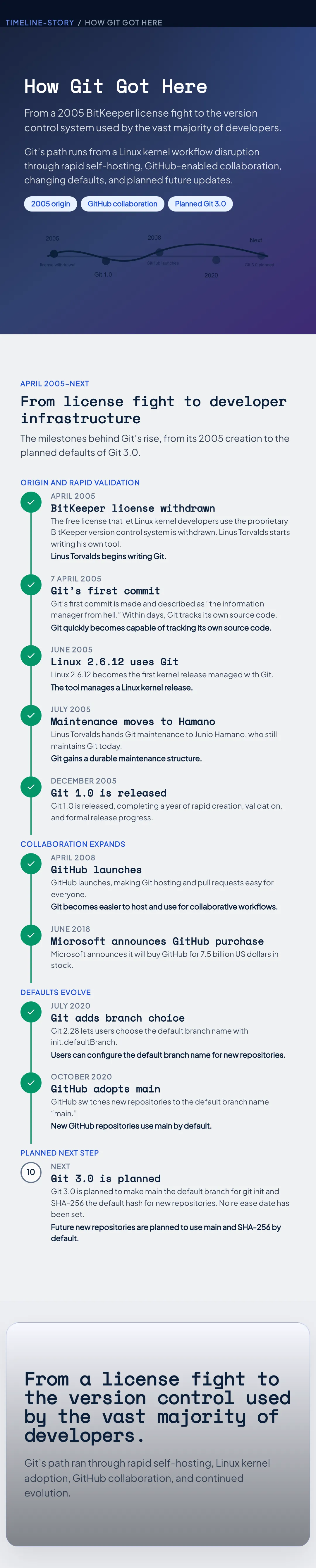
From a withdrawn license to a 1.0 release took about eight months. The visual sheet above groups these as "origin and rapid validation."
How it spread: GitHub
In April 2008, GitHub launched and made Git hosting and pull requests easy for everyone. Pull requests went mainstream.
Ten years later, in June 2018, Microsoft announced it would buy GitHub for 7.5 billion US dollars in stock.
How the defaults changed: master to main
For most of its life, Git named the first branch in a new repository master. Then:
- July 2020: Git 2.28 added the
init.defaultBranchsetting, so you could pick your own default branch name. - October 2020: GitHub switched new repositories to
main.
If you want this on your own machine, you can set it once:
git config --global init.defaultBranch main
The full timeline
| When | Milestone |
|---|---|
| April 2005 | BitKeeper's free license for Linux is withdrawn |
| 7 April 2005 | Git's first commit |
| June 2005 | Linux 2.6.12, the first kernel managed with Git |
| July 2005 | Junio Hamano takes over maintenance |
| December 2005 | Git 1.0 |
| April 2008 | GitHub launches |
| June 2018 | Microsoft announces it will buy GitHub for $7.5 billion |
| July 2020 | Git 2.28 adds init.defaultBranch |
| October 2020 | GitHub moves new repos to main |
| 2022 | Stack Overflow survey: 93% of developers use Git |
| Next | Git 3.0 plans main and SHA-256 as defaults |
What's next: Git 3.0
Git 3.0 plans two new defaults:
mainas the default branch name forgit init.- SHA-256 as the default hash for new repositories.
No release date has been set. If you're starting fresh today, setting init.defaultBranch to main already lines you up with the first change.
What to remember
If you only keep three things from this page, make them these:
- Git was born out of necessity. Linux lost its free BitKeeper license in April 2005, Linus Torvalds started writing his own tool, and Git's first commit landed on 7 April.
- It grew up fast. Within about eight months it was tracking its own code, managing a kernel release, had a new maintainer and shipped 1.0.
- It's still changing. Git 3.0 plans to change both the default branch name and the default hash for new repositories.
The next time you type git commit, you're using a tool that started as a fix for a license fight.
Sources
The Git project's release notes and breaking-changes docs, GitHub, Microsoft, and the Stack Overflow 2022 Developer Survey.
Frequently asked questions
Why was Git created?
Linux kernel developers had been using BitKeeper, a paid tool, under a free license. When that license was withdrawn in April 2005, Linus Torvalds started writing his own version control system, which became Git.
Who maintains Git today?
Junio Hamano. Linus Torvalds handed Git maintenance to him in July 2005, and he still maintains it.
When did Git switch from master to main?
Git 2.28, in July 2020, added the init.defaultBranch setting so you can choose the default branch name. GitHub moved new repositories to main in October 2020. Git 3.0 plans to make main the default for git init.
What is changing in Git 3.0?
Git 3.0 plans two new defaults: main as the default branch for git init, and SHA-256 as the default hash for new repositories. No release date has been set.