Tech explained
Credit vs Debit Card Explained: Fraud Protection Under US Law
Updated Nov 27, 2026 · 3 min read
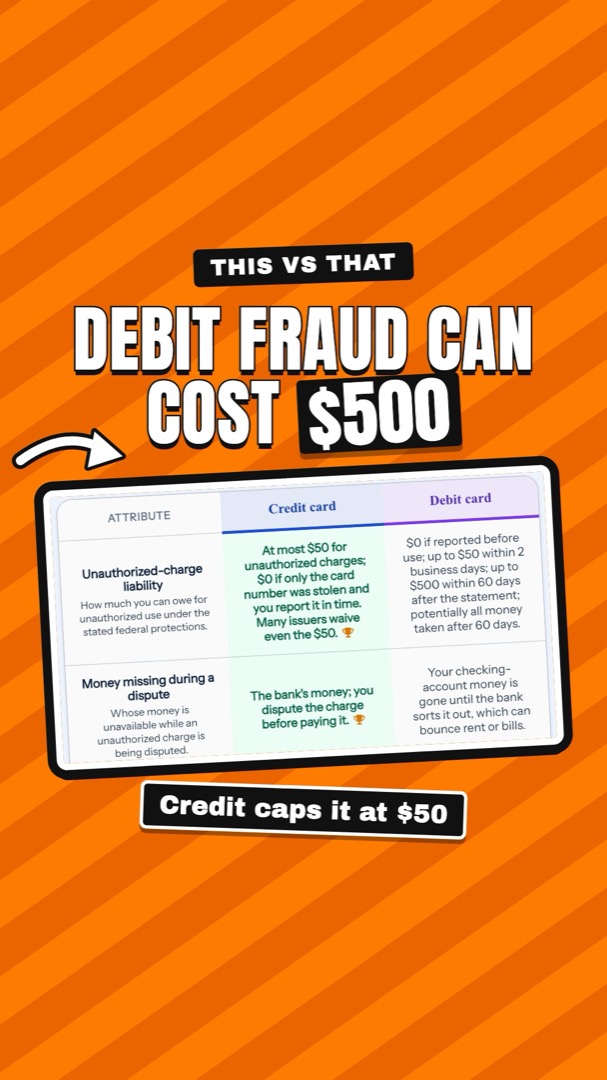
Under US law, the most you can owe for unauthorized credit card charges is 50 dollars, and nothing if only the card number was stolen and you report it in time. On a debit card it depends on how fast you report: up to 50 dollars within 2 business days, up to 500 within 60 days after your statement, and possibly everything taken after that. On debit, your own money is also missing while the bank investigates.
Key points
- ●Credit card: at most 50 dollars for unauthorized charges, and many issuers waive it.
- ●Debit card: 50 dollars within 2 business days, up to 500 within 60 days, then possibly all of it.
- ●On debit, your checking account money is gone during a dispute; on credit, you dispute before you pay.
- ●Debit stops you overspending; a credit card balance means paying interest.
- ●Either way, report a lost card or a strange charge right away.
The short answer
A credit card and a debit card look the same at checkout, but US law treats fraud on them very differently. On credit, the most you can owe is small and fixed. On debit, it depends on a clock, and the missing money is yours while the bank sorts it out.
This page covers what the law says, based on the US Federal Trade Commission's guidance. It describes the rules, not what any one person should do with their money.
Credit cards: the Fair Credit Billing Act
For unauthorized charges on a credit card:
- The most you can owe is 50 dollars.
- If only your card number was stolen, not the card itself, you owe nothing as long as you report it in time.
- Many card issuers waive even the 50 dollars.
Debit cards: the Electronic Fund Transfer Act
Debit and ATM cards fall under a different law, and the amount you could lose grows with time:
| When you report | The most you can lose |
|---|---|
| Before the card is used | 0 dollars |
| Within 2 business days of noticing | 50 dollars |
| Within 60 days after your statement | 500 dollars |
| After 60 days | Possibly all the money taken |
So the same theft can cost 50 dollars or everything, depending on how fast it's caught.
Two things follow from the table. First, the best case on debit, 0 dollars, only applies if you report before the card is used at all, so a lost card is worth reporting the minute you notice it's gone. Second, the 60-day window starts from your statement, not from the day of the charge. If you never open your statements, you can drift past it without realizing a charge was there. That's why the sheet's advice for debit users is to check the account often.
The bigger difference: whose money is missing
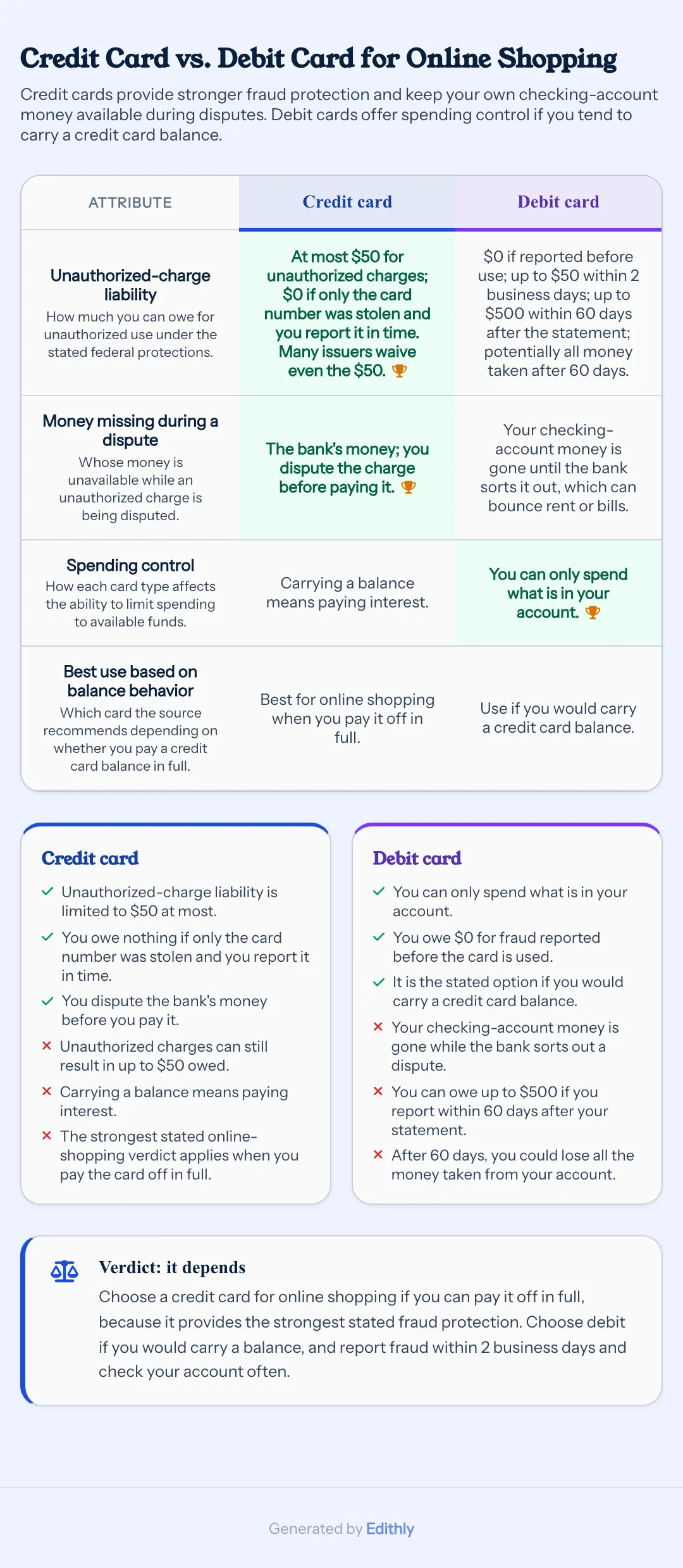
The liability caps get the attention, but the visual sheet above puts the day-to-day difference in its own row: whose money is gone during a dispute.
On a debit card, the charge comes straight out of your checking account. While the bank investigates, that money is missing. If it was meant for rent or bills, those payments can bounce.
On a credit card, the charge is the bank's money. You dispute it before you pay it, and your checking account isn't touched.
Where debit comes out ahead
Debit does win on one thing: you can only spend what's in your account, so you can't overspend. Carrying a balance on a credit card, on the other hand, means paying interest.
The side-by-side
| Credit card | Debit card | |
|---|---|---|
| Unauthorized charges | At most 50 dollars; 0 if only the number was stolen | 0 to 500 dollars, or all of it, depending on when you report |
| Money during a dispute | The bank's; you dispute before paying | Yours; gone until the bank sorts it out |
| Spending control | Carrying a balance means interest | Only what's in your account |
What the sheet concludes
The sheet's verdict is "it depends". It puts credit first for online shopping when the card is paid off in full, because of the stronger stated fraud protection, and debit for anyone who would carry a balance. If you use debit, it says to report fraud within 2 business days and check your account often.
Whatever card you use, the one rule that applies to both: report a lost card or a strange charge right away.
Sources
US Federal Trade Commission, "Lost or Stolen Credit, ATM, and Debit Cards", and the CFPB's Regulation E.
Frequently asked questions
Is a credit card or debit card safer for online shopping?
Under US law, a credit card caps what you can owe for unauthorized charges at 50 dollars, while debit liability grows the longer you wait to report. On debit, the missing money also comes out of your own checking account until the dispute is resolved.
How much can you lose with debit card fraud?
Per the FTC: nothing if you report before the card is used, up to 50 dollars if you report within 2 business days of noticing, up to 500 dollars within 60 days after your statement, and possibly all the money taken after 60 days.
Which laws cover credit and debit card fraud?
The Fair Credit Billing Act covers credit cards. The Electronic Fund Transfer Act, with the CFPB's Regulation E, covers debit and ATM cards.
Do I owe anything if only my card number was stolen?
For a credit card, no. If the physical card wasn't taken and you report the charges in time, the FTC says you owe nothing for them.