CS concepts
5 System Design Terms Explained in Plain English
Updated Nov 28, 2026 · 3 min read
Latency is how long one request takes; throughput is how many requests a system handles per second. A cache keeps a fast copy of data close by to cut latency, a load balancer spreads requests across servers, and sharding splits one big database by a key. Load balancers and sharding raise throughput; a cache cuts latency.
Key points
- ●Latency: how long one request takes, usually in milliseconds.
- ●Throughput: how many requests a system handles per second.
- ●Cache: a fast nearby copy, which can go stale.
- ●Load balancer: spreads requests across servers so none is swamped.
- ●Sharding: splits one big database by a key, each piece on its own server.

Five words you hear in every system design interview
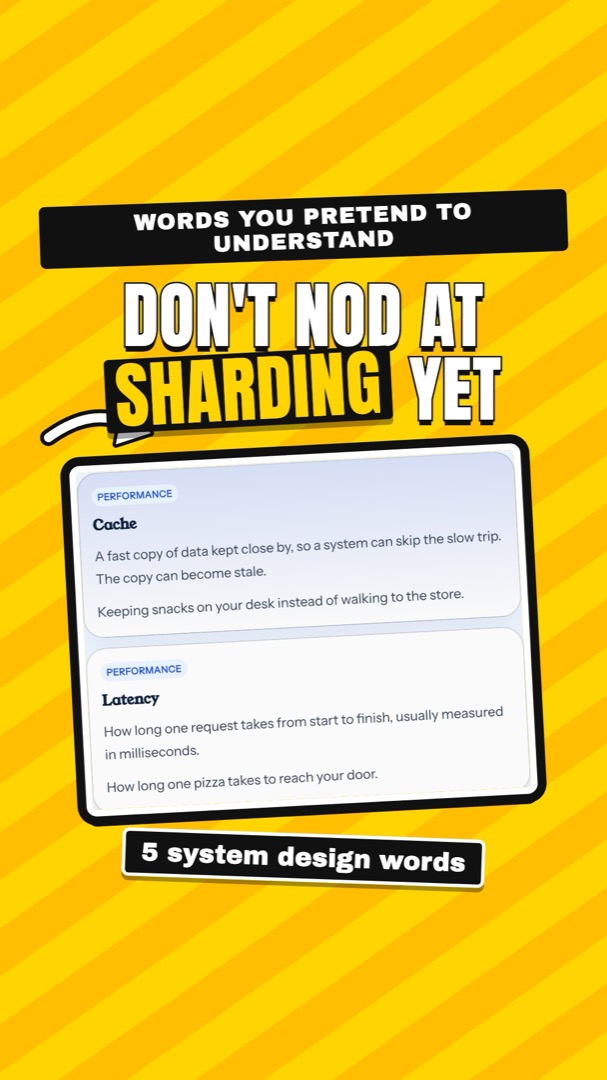
System design interviews lean on a handful of words that people often nod along to without being sure what they mean. Here are five of the most common, each with a plain definition and an everyday picture to hang it on. The visual sheet above groups them by category: three about performance, one about infrastructure and one about data architecture.
1 and 2. Latency and throughput
Latency is how long one request takes, start to finish, usually measured in milliseconds.
Everyday version: how long one pizza takes to reach your door. When someone says a page "feels slow", they're usually talking about latency.
Throughput is how many requests a system handles per second.
Everyday version: how many pizzas the shop delivers per hour.
Latency and throughput are easy to mix up because both sound like "speed". They're different. A shop can get each pizza to you quickly and still only manage a few an hour. A system can have low latency and low throughput, or high throughput with each request taking a while.
3. Cache
A cache is a fast copy of data kept close by, so you skip the slow trip.
Everyday version: snacks on your desk instead of walking to the store.
The catch is that the copy can go stale. If the store changes what's on the shelf, your desk snacks don't know. In a system, that means a cache can serve an old value until it's refreshed.
4 and 5. Load balancer and sharding
A load balancer sits in front of many servers and spreads incoming requests across them, so no single server is swamped.
Everyday version: a restaurant host seating guests at different tables, so one waiter isn't handling the whole room.
Then there's sharding: splitting one big database into pieces by a key, with each piece on its own server.
Everyday version: a phone book split into two volumes, A to M and N to Z. To find a name you only open one volume, and two people can look things up at the same time.
How the five connect
| Term | What it is | What it helps |
|---|---|---|
| Latency | Time for one request | The measure |
| Throughput | Requests per second | The measure |
| Cache | Fast nearby copy | Cuts latency |
| Load balancer | Spreads requests across servers | Raises throughput |
| Sharding | Splits data by a key | Raises throughput |
The short version for an interview: latency and throughput are what you measure. A cache cuts latency. A load balancer and sharding raise throughput.
Three mix-ups to avoid
"Faster" can mean two things. If an interviewer asks you to make a system faster, ask which they mean: each request finishing sooner (latency) or more requests handled per second (throughput). The fixes are different.
A load balancer doesn't split your data. Every server behind a load balancer can still talk to the same database. Sharding is the step that splits the data itself, so each server holds only its own slice, like one volume of the phone book.
A cache isn't the source of truth. It's a copy. The original data still lives somewhere slower, and the cache is only as good as how recently it was refreshed.
Using them in an interview
When you describe a design, tie each piece to the number it moves. "I'll put a cache in front of the database to cut latency on reads" says more than "I'll add a cache." And mention the trade-off you know about: a cache can go stale, so say how fresh the data needs to be.
Frequently asked questions
What is the difference between latency and throughput?
Latency is how long one request takes, like how long one pizza takes to reach your door. Throughput is how many requests the system handles per second, like how many pizzas the shop delivers per hour. A system can be fast for one request and still handle few of them, or the other way round.
Why can a cache return wrong data?
A cache is a copy. When the original data changes and the copy hasn't been updated yet, the cache is stale and serves the old value.
What is the difference between a load balancer and sharding?
A load balancer spreads incoming requests across many servers. Sharding splits the data itself into pieces by a key, so each server stores only part of it. Both raise throughput.
Does a cache improve latency or throughput?
A cache cuts latency, because it skips the slow trip to the original data.