Interview patterns
Prefix Sum Pattern Explained: Any Range Sum in One Subtraction
Updated Nov 27, 2026 · 3 min read
A prefix sum is a running total that starts at 0, so prefix[i] is the sum of the first i numbers. Build it once in O(n), and the sum of any inclusive range i to j is prefix[j + 1] minus prefix[i], one subtraction in O(1). It solves LeetCode 303, 560, 724 and 525.
Key points
- ●Start the prefix list at 0, then add each number to the last total.
- ●Range sum i..j inclusive = prefix[j + 1] - prefix[i].
- ●O(n) to build once, then O(1) per query instead of O(n).
- ●For subarray sum equals k, count prefix sums in a dict and add count[current - k].
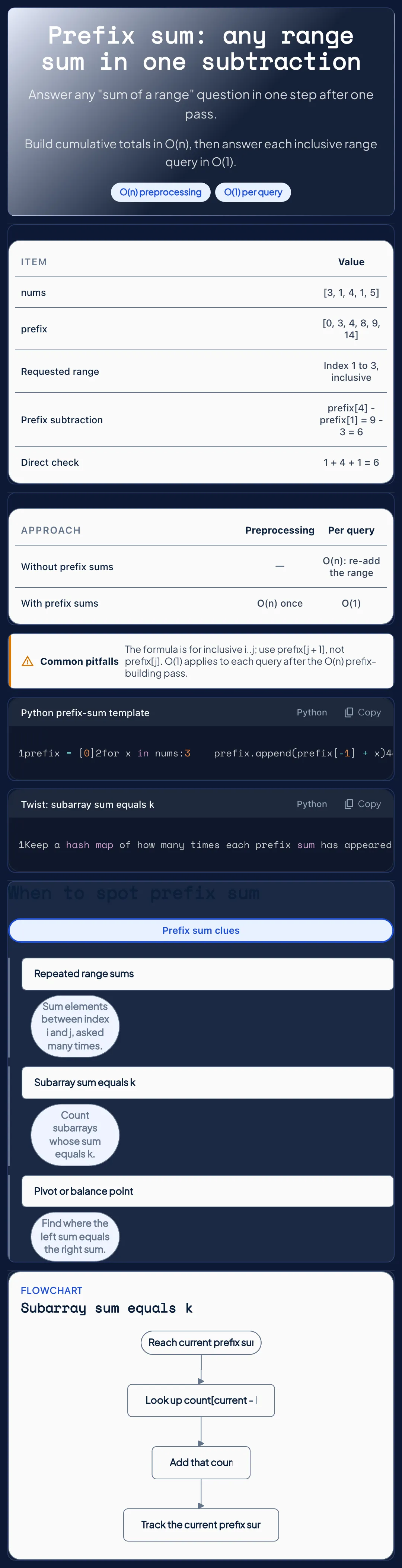
The clue: many sums on one list
You get a list that never changes and 1,000 questions, each one "what's the sum from index i to index j?" Re-adding the range every time costs O(n) per question. With a prefix sum, every answer is one subtraction.
Spot this pattern when a problem says:
- "sum of elements between i and j", asked many times
- "number of subarrays whose sum equals k"
- "pivot index where the left sum equals the right sum"
The idea: a running total with a 0 in front
Walk the list once and write down the total so far. Start with 0, and each step adds the next number.
| Index | 0 | 1 | 2 | 3 | 4 | 5 |
|---|---|---|---|---|---|---|
| nums | 3 | 1 | 4 | 1 | 5 | |
| prefix | 0 | 3 | 4 | 8 | 9 | 14 |
prefix[k] is the sum of the first k numbers. So the sum from i to j is everything up to j, minus everything before i:
range_sum(i, j) = prefix[j + 1] - prefix[i]
Trace one query
Sum of index 1 to 3, inclusive:
- prefix[4] = 9 (that's 3 + 1 + 4 + 1)
- prefix[1] = 3 (that's just the 3)
- 9 - 3 = 6
Check it directly: 1 + 4 + 1 = 6. The visual sheet above shows the same list, the prefix row and this subtraction side by side.
The code in Python
prefix = [0]
for x in nums:
    prefix.append(prefix[-1] + x)

def range_sum(i, j):  # inclusive i..j
    return prefix[j + 1] - prefix[i]
With nums = [3, 1, 4, 1, 5], prefix becomes [0, 3, 4, 8, 9, 14], and range_sum(1, 3) returns 9 - 3 = 6.
The twist: subarray sum equals k
LeetCode 560 asks how many subarrays add up to k. A subarray ending at the current spot sums to k exactly when some earlier prefix sum equals current - k. So keep a dict that counts every prefix sum you've seen, and at each step add count[current - k].
def subarray_sum(nums, k):
    count = {0: 1}  # the empty prefix
    current = ans = 0
    for x in nums:
        current += x
        ans += count.get(current - k, 0)
        count[current] = count.get(current, 0) + 1
    return ans
For [1, 1, 1] and k = 2 it returns 2: the first two ones and the last two.
Complexity
| Approach | Preprocessing | Per query |
|---|---|---|
| Without prefix sums | none | O(n), re-add the range |
| With prefix sums | O(n) once | O(1) |
The O(1) only counts after you've paid the O(n) to build the list once. For a single query, just add the numbers. For 1,000 queries on 1,000 numbers, it's the difference between up to a million additions and about two thousand steps.
The trap
The formula is for an inclusive range, so it's prefix[j + 1], not prefix[j]. Using prefix[j] drops the last number. That off-by-one is the bug the 0 at the front sets up, and it's the most common one with this pattern.
Quick check: if a prefix list is 0, 2, 7, 9, the original numbers are 2, 5, 2. The second number is 7 - 2 = 5.
Where it shows up
- 303 Range Sum Query
- 560 Subarray Sum Equals K
- 724 Find Pivot Index
- 525 Contiguous Array
- 238 Product of Array Except Self, with prefix products instead of sums
Frequently asked questions
What is a prefix sum?
A list of running totals with a 0 in front. For [3, 1, 4, 1, 5] it's [0, 3, 4, 8, 9, 14]. Entry i holds the sum of the first i numbers.
Why does the prefix sum list start with 0?
So every range has the same formula. The sum from index 0 to j is prefix[j + 1] - prefix[0], and prefix[0] = 0 makes that just prefix[j + 1], with no special case.
What is the time complexity of prefix sum?
O(n) once to build the running totals, then O(1) for each range-sum query. Without it, each query re-adds the range and costs O(n).
How does prefix sum solve Subarray Sum Equals K?
A subarray ending here sums to k when some earlier prefix equals current - k. Keep a dict counting how many times each prefix sum has appeared, and at each step add count[current - k] to the answer.